Surveys On The Go: Earn Cash
- 4.4
- Rating
- 5.00M
- Installs
- Free
- Price

 Analysis by App-foxy
I like survey apps most when they are honest about what they offer. Surveys On The Go takes a straightforward approach: it lets me answer market-research surveys from my phone and receive cash rather than collecting an in-app points balance. That single capability shapes the whole experience. This is not a replacement for a job, and it is not a reliable way to earn a fixed amount every day, but it can turn spare minutes into a small, tangible payout.
After using it as a lifestyle app, I found the main appeal easy to understand. I can check for available questionnaires while waiting for an appointment, riding public transport, or taking a short break. The app is free, is suitable for Everyone, and comes from MFour Mobile Research, Inc. Its long presence in the category also shows in its established audience: it has passed one million installs, with an average rating of 4.2 from around 127 thousand ratings.
Cash surveys are the feature that changes the experience
The important distinction here is the payment model. Many survey services make the user build up points, then convert those points into gift cards or other rewards. Surveys On The Go presents itself around real cash instead. In practical terms, that makes each completed questionnaire easier to understand: I am spending time for a possible cash return, not trying to interpret an artificial points economy.
You May Also Like

 Blood Strike: 2.5 Anniversary
Blood Strike’s Loadouts Turn Every Drop Into a Tactical Gamble
A close look at Blood Strike’s custom loadouts: how fast access to signature weapons reshapes its battle royale rhythm, rewards preparation, and narrows the gap between fights.

 Pandora - Music & Podcasts
Pandora’s Music Is Easy to Start, but Harder to Recover
Pandora’s strength is its low-effort path from a seed to a station. Its weak spot is how much confidence it asks you to place in connection, setup, and quiet recovery.

 8 Ball Pool
 Is Built on Rivalries, Rematches, and Routine
A close look at the rivalries, rematches, shared routines, and unanswered safety questions that turn a quick pool match into a persistent mobile community.

 Samsung Music
’s Quiet Strength Is Playing What You Already Own
Its reach comes less from spectacle than from dependable access to a personal library. That simplicity is both the app’s strongest retention engine and its ceiling.

 AccuWeather: Weather Radar
AccuWeather Review: A Quick, Clear Forecast for Everyday Decisions
For everyday plans, the best forecast is the one you can understand quickly. AccuWeather makes rain timing, radar, and local conditions easy to act on, with a few trade-offs.

 Hill Climb Racing
Why Hill Climb Racing Still Turns Crashes Into One More Run
A tiny car, a bumpy hill and one more upgrade: Hill Climb Racing keeps resurfacing because its simple chaos makes every near-miss feel personal.
More From Our News Desk



That does not make every survey equally worthwhile. A short questionnaire can feel reasonable when I am already idle, while a longer or more detailed one may not justify interrupting something else. The cash-based approach removes one layer of confusion, but it does not remove the usual survey tradeoff: availability, length, and eligibility determine whether a particular opportunity is useful.
I also appreciate that this capability fits naturally into a phone-based routine. I do not need to sit at a computer or reserve a full evening. The app belongs in the category of small, occasional earning tools rather than serious income platforms. That distinction matters because it sets the right expectation from the start. If I open it hoping to cover a bill, I am likely to be disappointed. If I open it when I have a few unused minutes, the experience makes more sense.
What answering a survey feels like
The usual workflow is simple: open the app, look for an available survey, read the opening questions, and decide whether to continue. Eligibility is part of the process. A questionnaire may be aimed at a particular kind of consumer, so answering initial screening questions does not guarantee that I will reach the main survey. This is one of the first things a new user should understand, because being screened out is normal for research apps and can make the time feel less productive.
My best habit is to read the early questions carefully rather than rushing through them. Survey services are built around consistent answers, and careless tapping can make a questionnaire frustrating or reduce confidence in the result. I treat each survey like a short task: I answer based on my actual habits, avoid guessing when a question is unclear, and leave if the time commitment no longer feels worthwhile.
For people concerned about wasting mobile data or battery, the sensible workflow is to use the app when connected to a trusted Wi-Fi network and when the phone is not needed for something urgent. I would not launch it during a meeting, while driving, or in any situation where a notification or questionnaire could distract me. The app is designed for convenience, but convenience still depends on using it at the right moment.
How I decide whether a survey is worth opening
I do not treat every available questionnaire as an automatic yes. I first consider how much attention I have and whether I can finish without interruption. A survey that fits into a waiting period is more attractive than one that starts just before I need to leave. This small decision makes the cash model feel more practical because I am exchanging genuinely unused time instead of sacrificing time I value more.
A second useful habit is to keep expectations flexible. Survey availability can vary, and the app should not be treated like a schedule with guaranteed daily assignments. I check occasionally rather than repeatedly refreshing it. Constant checking creates the impression that I am working for the app, even when no suitable questionnaire is available.
The third habit is to keep profile answers accurate and consistent. Research matching depends on knowing what kind of participant I am. Changing answers simply to qualify for more surveys is a poor strategy: it can lead to unsuitable questionnaires and makes the experience less trustworthy. Honest answers may mean fewer invitations, but they make the surveys I do receive more relevant.
A realistic everyday use case
Imagine I have a twenty-minute wait before an appointment. I open Surveys On The Go, review the available opportunity, and begin only if the questionnaire appears manageable within that window. If the opening questions show that I am not the intended participant, I move on rather than forcing the process. If I qualify, I answer carefully and finish before my appointment begins.
That scenario captures the app’s strongest use case. The value comes from fitting a small task into time that would otherwise be idle. The same approach works during a commute when I am a passenger, during a lunch break after eating, or while waiting for a service appointment. It is less suitable when I am already tired, rushed, or trying to multitask.
I would also avoid making a survey session part of a child’s routine simply because the app carries an Everyone age rating. The rating makes it broadly accessible as an app, but survey participation still involves personal opinions and consumer information. In my view, adults should decide whether the activity is appropriate for their household and should supervise younger users rather than assuming the age label answers every practical question.
The cash promise is useful, but it is not instant income
The phrase “real cash” is the reason many people will try this app, and it is a meaningful advantage over point-heavy alternatives. Still, users should separate the idea of cash rewards from the idea of immediate money in hand. A completed survey is part of an earning process, not a guarantee of instant access to funds. I would check the app’s current payment instructions and account requirements before investing significant time, especially if the timing of a payout matters to me.
This is also why I would not compare the app directly with freelance marketplaces, delivery work, or other platforms that offer larger tasks. Those alternatives may require more effort, equipment, travel, or scheduling, but they are better suited to people seeking substantial income. Surveys On The Go is closer to a pocket-sized side activity. Its advantage is low commitment, not earning power.
Where the experience can become frustrating
The biggest friction is uncertainty. I may open the app and find nothing that fits, or begin a questionnaire only to discover that I am not eligible. That is not necessarily a defect in the app; it is a consequence of how targeted research works. Even so, it affects how I judge the experience. Someone who dislikes unanswered screening questions or variable availability may find the process irritating.
Another limitation is attention. A survey can look easy at first and then require more concentration than expected. I would not start one while cooking, walking through traffic, or switching between work messages. The app rewards calm, focused use, and it is less convenient when I have to stop halfway through.
There is also a psychological tradeoff. Because the app is free and easy to open, it can encourage frequent checking. That can turn a supposedly casual activity into a repetitive search for opportunities. I get better results by setting a personal rule: check when I already have spare time, not whenever I feel the need to earn something.
How it compares with ordinary survey alternatives
Compared with reward apps built around points, Surveys On The Go has a clearer central promise because the reward is framed as cash. I do not have to mentally translate a balance into a possible reward category while deciding whether a questionnaire is worthwhile. That simplicity is a genuine strength for users who want a direct relationship between participation and payment.
Compared with general-purpose cashback apps, the experience is different. Cashback tools usually depend on shopping or completing purchases, while this app asks for opinions and consumer responses. Someone who already shops online frequently may get more value from cashback, whereas someone with spare time but little interest in changing shopping habits may prefer surveys.
Compared with paid freelance work, the app is far easier to start but much less predictable and limited in earning potential. I would choose it for a waiting room, not for a financial plan. That is the most useful comparison because it prevents the common mistake of judging a lightweight survey tool by the standards of a full income platform.
Details that matter before committing time
The app is free to download, which lowers the barrier to trying it. Its current version is 2.67.0, and it supports devices running Android 7.0 or later. Those details are worth checking before installation, particularly if I use an older phone. A free app is only convenient if it runs on the device I actually carry.
Surveys On The Go was released on October 12, 2011, and the developer is MFour Mobile Research, Inc. The large number of ratings and more than a million installs make it feel like an established option rather than a brand-new experiment. I still would not treat popularity as proof that every user will have the same survey supply or payout experience. My own results would depend on eligibility, timing, and how often I check.
The app’s lifestyle classification is appropriate because it supports a habit rather than a single urgent task. I can use it alongside other routines, but it does not need to dominate them. The best way to keep it useful is to view each survey as an optional opportunity, not an obligation.
Who will get the most from it
I think the strongest audience is people who regularly have short, predictable gaps in their day and are comfortable answering questions carefully. Students with waiting periods between classes, commuters who are passengers, and adults who spend time in queues may find the format easy to fit into their routines. The cash-based reward is especially appealing to anyone who dislikes complicated point conversions.
It can also suit users who want a low-risk way to test survey earning without paying an entry fee. Since the app is free and carries an Everyone rating, trying it does not require a major commitment. I would begin with a few sessions, observe how often suitable questionnaires appear, and decide whether the time-to-reward balance feels reasonable for me.
I would skip it if I need guaranteed assignments, predictable hourly earnings, or immediate financial results. I would also skip it if answering screening questions feels more annoying than useful, or if I am unwilling to provide the kind of personal opinions that market research requires. In those cases, a cashback service, freelance platform, or another earning method may be a better match.
My final take after using it as a spare-time tool
Surveys On The Go succeeds because it keeps its main idea easy to grasp: answer surveys when suitable opportunities appear and work toward cash rather than an abstract points balance. That does not eliminate the uncertainty of survey work, but it makes the reward structure more understandable and the app easier to evaluate honestly.
My recommendation is cautious but positive. I would keep it installed if I had regular idle moments and wanted an occasional, low-commitment activity. I would not depend on it for bills, plan my day around it, or assume every survey will be worth opening. Used with realistic expectations, it can make otherwise empty minutes a little more productive.
For me, the deciding question is not whether it can replace paid work. It cannot fill that role. The better question is whether I would rather spend a spare few minutes answering a focused questionnaire than scrolling without purpose. When the answer is yes, the app’s direct cash approach gives it a clear advantage over many ordinary reward alternatives.
FAQs for Surveys On The Go: Earn Cash
01What is Surveys On The Go and how does it work?
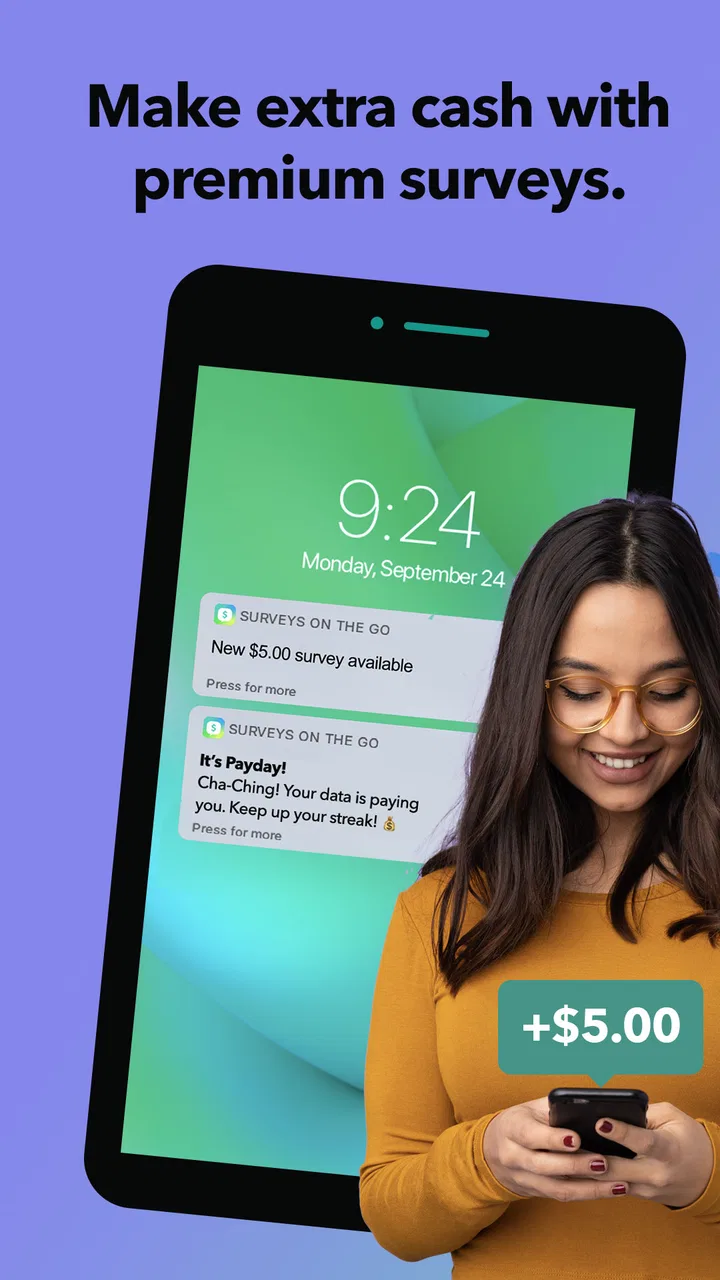
Surveys On The Go is a mobile app that allows users to earn money by completing surveys. Once you download the app, you'll receive notifications about available surveys that match your profile. After completing a survey, your account is credited with a specified amount, which you can cash out once you reach the minimum payout threshold.
02Is Surveys On The Go free to use?
Yes, Surveys On The Go is completely free to download and use. There are no hidden fees or costs associated with participating in surveys. The app aims to provide users with an easy way to earn extra income without any upfront investment or subscription fees.
03How much money can I make with Surveys On The Go?
The amount you can earn varies depending on the number and type of surveys you complete. Surveys typically pay between $0.50 to $5.00 each, with some offering even higher rewards. While it's not a full-time income source, it can be a convenient way to earn extra cash during your free time.
04What are the minimum requirements to cash out earnings?
To cash out your earnings on Surveys On The Go, you need to accumulate at least $10. Once you reach this threshold, you can choose from several payout options, including PayPal or gift cards. The app makes it straightforward to track your earnings and initiate a payout when you're ready.
05Is my personal information safe with Surveys On The Go?
Surveys On The Go prioritizes user privacy and data security. The app requires basic demographic information to match you with suitable surveys, but it ensures that your personal data is kept confidential and secure. They comply with industry standards to protect user information and do not sell your data to third parties.
Pros
- User-friendly interface for easy navigation.
- Earn cash rewards for completing surveys.
- Diverse range of survey topics available.
- Quick survey completion with short tasks.
- Reliable payment system via PayPal.
Cons
- Limited availability of surveys at times.
- Requires location access for surveys.
- Some surveys can be time-consuming.
- Occasional app crashes reported.
- Minimum payout threshold may be high.

Surveys On The Go: Earn Cash
Gallery